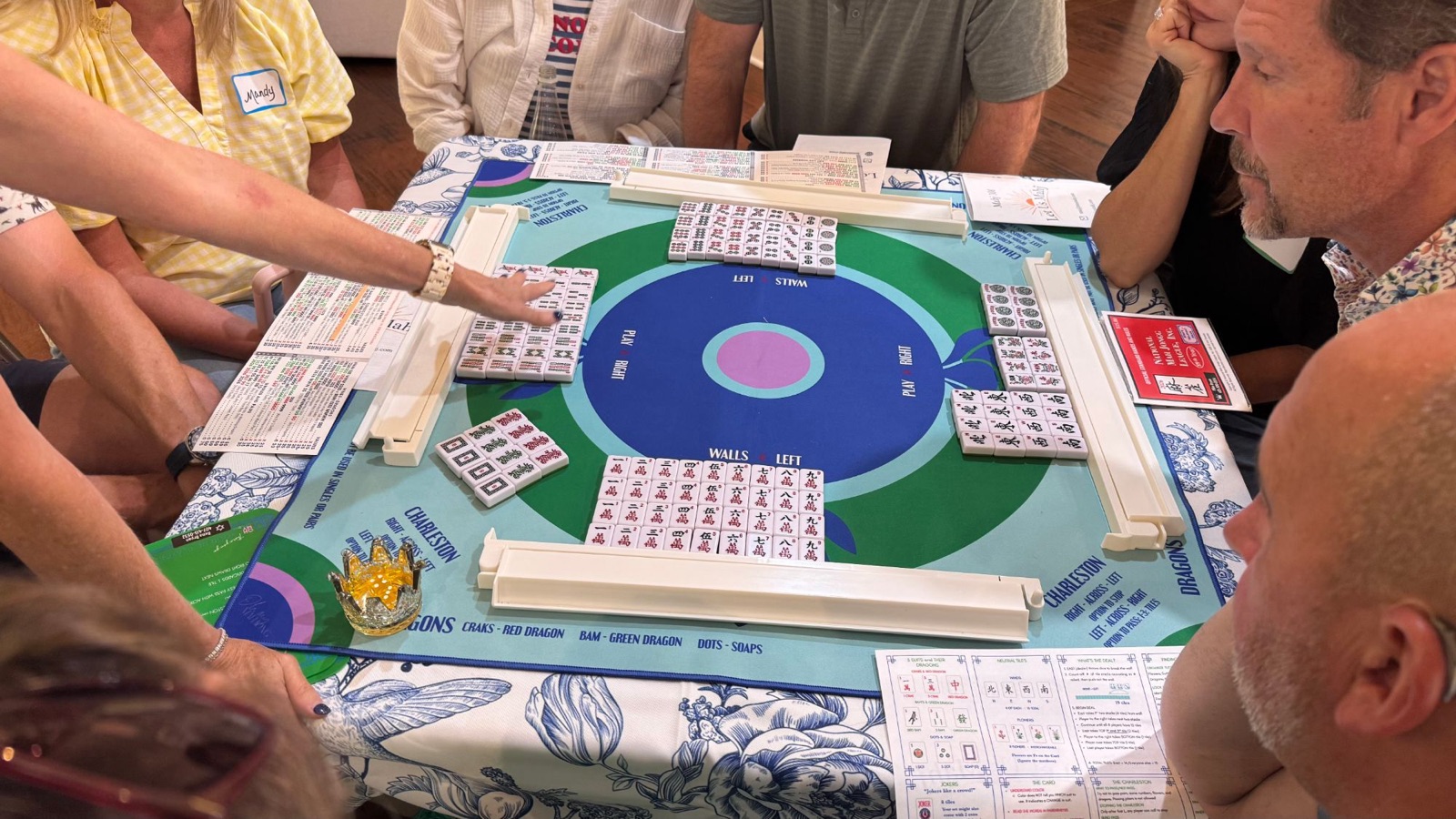
Learn to play American Mah Jongg
Everything you need for your first game, in the order you'll use it. Read it before class, bring questions, and we'll put it into practice together.
1. The goal of the game
Four players each try to be the first to build a winning 14-tile hand. Every winning hand must match one of the patterns printed on the official card issued each year by the National Mah Jongg League (NMJL). Think of the card as your menu: you pick a hand that suits your tiles, then draw and discard until your rack matches it exactly.
2. Meet the tiles
An American set has 152 tiles. Here's how they break down:
| Group | Count | What to know |
|---|---|---|
| Bams (bamboo) | 36 | Numbered 1–9, four of each. The 1 Bam is usually a bird. |
| Craks (characters) | 36 | Numbered 1–9, four of each. Look for the red 萬 symbol and the number in the corner. |
| Dots (circles) | 36 | Numbered 1–9, four of each. Count the circles. |
| Winds | 16 | North, East, West, South: four of each. Remember "NEWS". |
| Dragons | 12 | Four each of Red, Green and White ("Soap"). Each dragon "belongs" to a suit (below). |
| Flowers | 8 | All flowers are interchangeable, whatever picture or season is printed on them. |
| Jokers | 8 | Wild tiles, with special rules. See Jokers. |
Dragons and their suits
Each dragon is matched to one suit. You'll need this whenever the card asks for "matching" or "opposite" dragons:
Rena's memory trick: Green Bamboo grows, Red Craks crackle, and Soap makes bubbles, which are dots! On year hands (like 2026), Soap also stands in for the zero and can be used with any suit.
3. Reading the card
The card is grouped into sections such as the current year, 2468 (evens), Like Numbers, Addition hands, Quints, Consecutive Runs, 13579 (odds), Winds & Dragons, 369, and Singles & Pairs. Each line is one possible hand. Here's how to read it:
- Colors show suits. One color means one suit, two colors mean two different suits, three colors mean all three. The actual colors on the card don't mean Bam, Crak or Dot. They just mean "same" or "different."
- Groupings are separated by spaces: a pair (2 alike), pung (3), kong (4), quint (5).
- X or C at the right: X = exposed. You may call discards to make groups. C = concealed. You may only call a discard for the very last tile you need to win.
- The number at the far right is the hand's value, used for scoring.
- Notes in parentheses, like "Any 3 consecutive numbers" or "These numbers only," tell you what you may change and what you may not. Read them every time.
Always play from the current year's card. A new card comes out every April, and last year's hands are no longer valid. Order yours from the National Mah Jongg League. Large-print cards are available too.
4. Building the wall & dealing
- Pick East. Each player rolls the dice; the highest roll is East (the dealer). Seats then go counter-clockwise: East, South, West, North.
- Shuffle and build. Turn all tiles face down and mix them. Each player builds a wall 19 tiles long and 2 tiles high (38 tiles) and pushes it toward the center, usually with racks.
- Break the wall. East rolls the dice and counts that many stacks from the right end of their own wall to "break" it.
- Deal. Starting with East and moving counter-clockwise, each player takes 2 stacks (4 tiles) at a time until everyone has 12. Then East takes 2 more tiles and everyone else takes 1. East has 14 tiles; everyone else has 13.
- Rack and study. Stand your tiles on your rack, sort them by suit, and look at the card for 2–3 hands that fit what you're holding.
5. The Charleston
Before play begins, everyone trades unwanted tiles in a series of passes called the Charleston. Each pass is three tiles, passed face down. Jokers can never be passed.
| Stage | Pass order | Notes |
|---|---|---|
| First Charleston (required) | Right → Across → Left | On the first Left you may "blind pass": pass on 1, 2 or 3 of the tiles you were just handed without looking at them. |
| Second Charleston (optional) | Left → Across → Right | Any player may stop it before it begins. On the last Right, blind passing is allowed again. |
| Courtesy pass (optional) | Across only | You and the player across agree on 0–3 tiles. If you disagree, the lower number wins. |
Easy way to remember it: "Right, Across, Left… Left, Across, Right." The second Charleston is the first one in reverse. Want to pass smarter? See Charleston & Tips.
6. Taking turns
- East starts by discarding one tile into the center, face up, and saying its name out loud ("Three Bam").
- Play moves to the right (counter-clockwise). On your turn you pick one tile from the wall, then discard one tile. You always end your turn holding 13.
- Always name your discard clearly. Take your time and look before you speak.
- The game ends when someone declares Mah Jongg, or when the wall runs out. A game with no winner is a wall game, and no one pays.
7. Calling a discard
When someone discards a tile you need, you can call it, even when it isn't your turn. Say "Call!" (or "Take!") before the next player picks a tile or racks the discard.
- You may call a discard to complete a pung, kong or quint. Expose that whole group face-up on top of your rack, then discard. Play continues from your right, so players in between lose their turn.
- You may not call a discard to make a pair or a single, unless it's the last tile you need for Mah Jongg.
- On concealed (C) hands you may only call the final tile for Mah Jongg.
- If two people call the same tile, the player calling for Mah Jongg wins it. Otherwise the player next in turn gets it.
Once you expose, everyone can see what you're building, so think before you call.
8. Jokers
- A Joker can stand in for any tile in a pung, kong or quint (groups of 3 or more).
- A Joker can never be used in a single or a pair, and that includes the pair in your winning hand.
- Joker exchange: on your turn, if any player has an exposed group with a Joker in it and you hold the real tile it stands for, you may swap your tile for that Joker. You can do this after picking from the wall, or after calling a discard and exposing.
- A discarded Joker is "dead" and can't be called. When you throw a Joker, name it as the tile discarded just before it ("Joker, same as 5 Dot").
Exposed kong of 7 Craks using one Joker. If you hold a 7 Crak, you can swap it for that Joker on your turn.
9. Declaring Mahj!
When your 14 tiles exactly match a hand on the card, by drawing the last tile or calling it, say "Mah Jongg!" and lay your whole hand face up. Leave it there until the other players have checked it against the card.
- Never throw in your hand until the winner's hand has been verified. If they made a mistake, play can sometimes continue.
- Calling Mah Jongg by mistake and exposing tiles can leave your hand "dead" for the rest of the game. When in doubt, check the card twice.
- Scoring and payment basics are on the NMJL Rules page.
10. Words you'll hear at the table
| Term | Meaning |
|---|---|
| Pair / Pung / Kong / Quint | 2 / 3 / 4 / 5 identical tiles (Jokers allowed in 3+) |
| Sextet | 6 identical tiles (only possible with Jokers or Flowers) |
| Exposure | A group you've called and placed face-up on your rack |
| Hot tile | A tile that's dangerous to discard because someone is likely waiting for it |
| Dead hand | A hand that can no longer win. The player stops picking and discarding but still pays. |
| Wall game | The wall runs out with no winner |
| Blind pass / Steal | Passing tiles you just received in the Charleston without looking at them |
| Soap | The White Dragon, which also counts as 0 in year hands |
| "Mahj!" | The happiest word in the game |
Next steps: look through the Winning Hands diagrams, then download Rena's After Class Reminders to keep next to your rack.
11. Practice online
Between classes, the fastest way to improve is to play lots of hands. You can do that from home, online, any time you like.
I Love Mahj: practice between classes
I Love Mahj is an online American Mah Jongg app where you can play practice games at your own pace. It's a great way to get faster at reading the card, try out Charleston passes and build confidence before you sit down at a live table.
Use Rena's code when you sign up and get a 3-week free trial instead of the usual 2 weeks.
Visit ilovemahj.comThis is Rena's affiliate code for I Love Mahj.