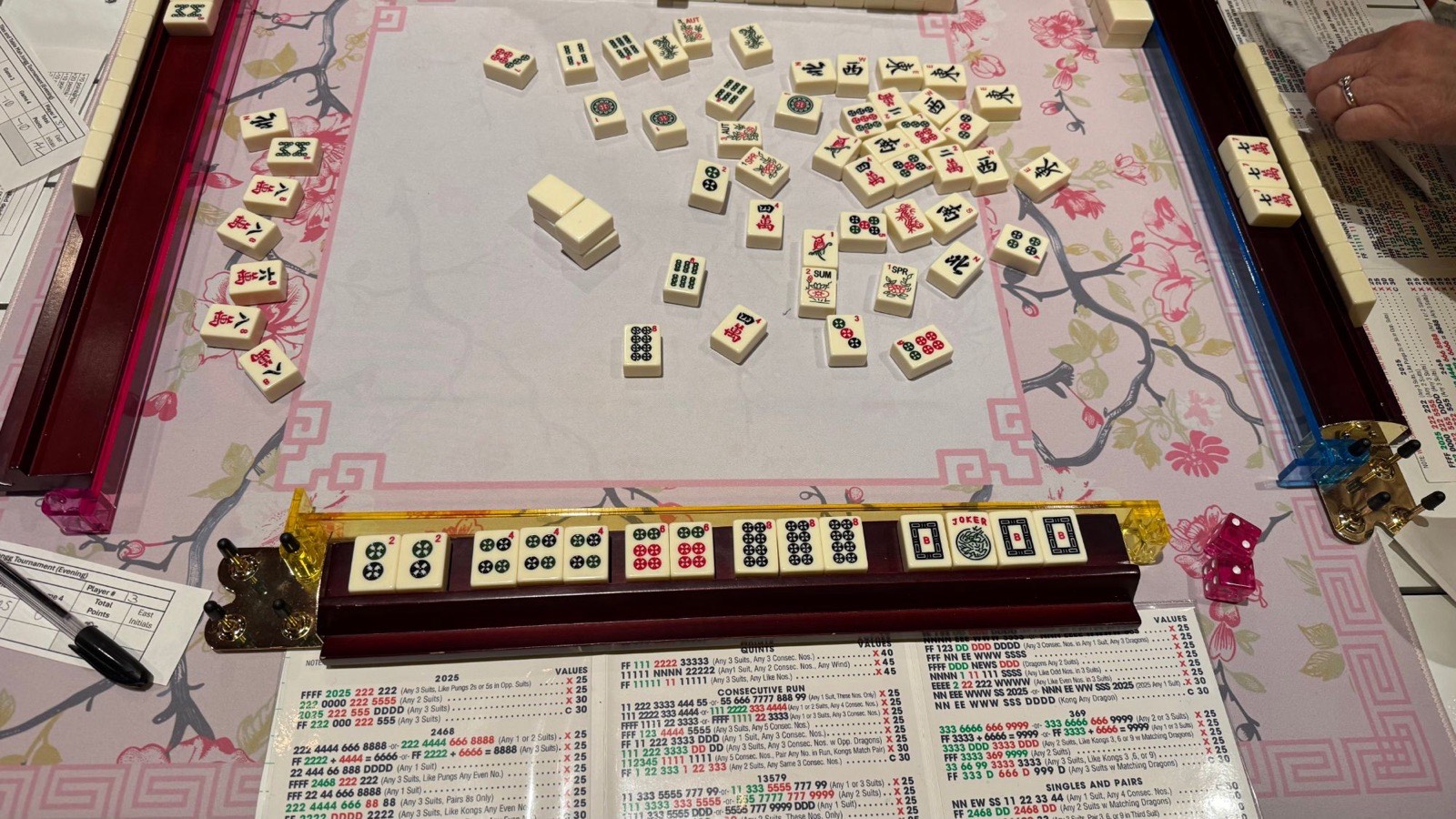
National Mah Jongg League rules
American Mah Jongg is played by the rules of the National Mah Jongg League (NMJL), founded in New York in 1937. This page summarizes the rules you'll use at a standard table.
Please note: this is Rena's teaching summary, not the official text. For the complete rules and rulings, get the NMJL's official rule book Mah Jongg Made Easy and the current card from nationalmahjonggleague.org. Tournaments and leagues may add house rules, so always ask before you start.
1. Equipment
- 152 tiles: 108 suit tiles (Bams, Craks and Dots, 1–9, four of each), 16 Winds, 12 Dragons, 8 Flowers and 8 Jokers.
- Four racks, often with pushers, to hold tiles and move the wall.
- Two dice to break the wall.
- A current NMJL card for each player. Only the current year's card is valid.
- Optional: a table mat, and coins or chips for scoring.
2. Seating, the wall & the deal
- The player with the highest roll is East (dealer). After each game, East passes to the right.
- Each player builds a wall 19 tiles long and 2 high. East rolls the dice and breaks their own wall that many stacks from the right.
- Tiles are dealt counter-clockwise in groups of four until everyone has 12. East then takes 2 more and the other players take 1. East starts with 14 tiles, everyone else with 13.
- Count your tiles before the Charleston. A wrong count found later can make your hand dead.
3. The Charleston
- First Charleston (required): pass 3 tiles Right, 3 Across, 3 Left.
- Second Charleston (optional): Left, Across, Right. Any one player may stop it before the first pass of the second Charleston, without giving a reason.
- Blind passing: allowed only on the last pass of each Charleston (the first Left and the second Right). You may pass along 1, 2 or 3 of the tiles you're receiving without looking at them.
- Optional courtesy pass: after the Charleston, players across from each other may trade 0–3 tiles. If you disagree on the number, the lower number is used.
- Jokers may never be passed during any part of the Charleston.
- Tiles are passed face down. Pick up what you received only after you've passed your own tiles.
4. Play & discards
- East opens play by discarding. Play then moves to the right (counter-clockwise).
- Each turn: pick a tile from the wall (or call a discard), then discard one tile face up and name it out loud.
- If a discard is named wrong, point it out right away. The official rule book explains how a misnamed tile is handled.
- A discard can be called until the next player has picked from the wall and racked the tile, or has discarded.
- When the wall is used up and no one has won, it's a wall game. There's no payment, and the deal passes to the right.
5. Calling & exposures
- You may call a discard to complete a pung, kong, quint or sextet for an exposed (X) hand. Expose the group face up, then discard.
- You may not call a discard for a single or a pair, except for the last tile for Mah Jongg.
- Concealed (C) hands: you may only call the last tile for Mah Jongg.
- Who gets it: a call for Mah Jongg beats a call for an exposure. If two players call for an exposure (or both for Mah Jongg), the player next in turn gets the tile.
- You may change your mind about calling only before you expose any tiles. Once tiles are exposed, you must complete the exposure.
- Exposures stay as they are. They can't be broken up, rearranged or taken back into your hand.
6. Joker rules
- Jokers may be used in any group of three or more identical tiles.
- Jokers may never be used for a single tile or in a pair, including in Singles & Pairs hands.
- Exchanging: on your turn, after picking from the wall or calling a discard, you may give the real tile for any Joker in any player's exposure, including your own. You may make more than one exchange per turn.
- A discarded Joker can't be called for an exposure or Mah Jongg. Name it as the previous discard.
7. Dead hands & errors
A hand is declared dead when it can no longer win. The dead player stops picking and discarding but stays at the table, and pays the winner if someone wins. A hand becomes dead when:
- The player has the wrong number of tiles.
- Another player correctly points out that the player's exposures don't match any hand on the card. That player's own hand must be at stake, and it's polite to be sure first.
- The player declared Mah Jongg in error and exposed their hand.
Be certain before you call a hand dead. In league or tournament play, ask the director to rule.
8. Mah Jongg & scoring
When you complete a hand, call "Mah Jongg," expose all 14 tiles, and let the table check it against the card. Other players keep their tiles until the win is confirmed.
| How you won | Who pays |
|---|---|
| On another player's discard | The discarder pays double the hand's value. The other two pay the value once. |
| Self-picked from the wall | All three players pay double. |
| Jokerless hand (no Jokers used) | Values are doubled again. This does not apply to Singles & Pairs hands, which can't use Jokers anyway. |
| Wall game | No one pays. |
Example: you win a 25-point hand on a discard. The discarder pays 50, the other two each pay 25. Leagues and tournaments often keep score on paper with bonus points instead of coins. Rena's league will post its scoring rules on the League page.
9. Table etiquette
- Name every discard clearly, and give others a moment to call before you pick.
- Don't pick from the wall before the previous player has finished their turn.
- No coaching others during play, unless everyone agrees it's a practice game.
- Keep tiles on your rack, and don't touch the wall out of turn.
- Win graciously, lose cheerfully, and help rebuild the wall!