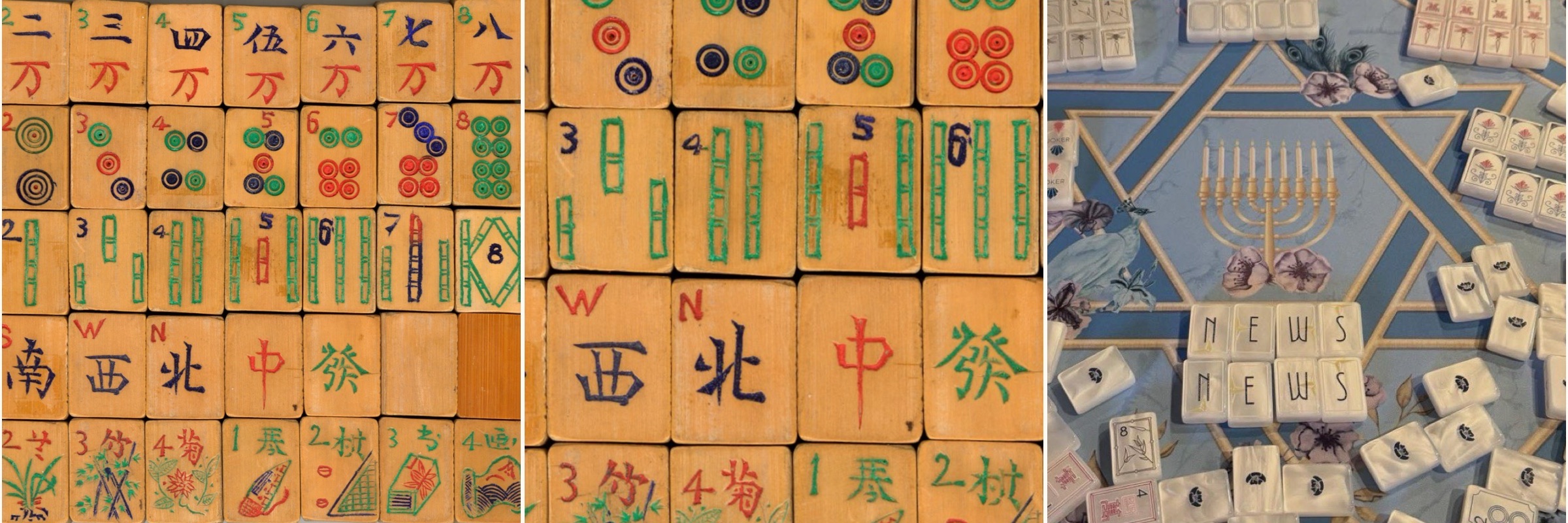
The history of Mah Jongg
The tiles on your rack carry a story that spans 150 years, two continents and many generations of players. Here's how a Chinese parlor game became a beloved American tradition.
A game with a legendary past
Ask around a Mah Jongg table where the game came from and you'll hear some wonderful stories. One says Confucius invented it around 500 BC, naming the three Dragons after his three cardinal virtues. Another credits an ancient emperor, or the sailors who played it to pass long voyages. These legends are fun, and they're part of the game's charm. But historians who have studied the game haven't found evidence that it is anywhere near that old.
What the evidence does suggest is that Mah Jongg took shape in eastern China during the Qing dynasty, in the second half of the 1800s. The earliest surviving sets and written descriptions point to the busy coastal region around Ningbo, Shanghai and the Yangtze River delta. Exactly who invented it, and when, has been lost to history.
From cards to tiles
Mah Jongg didn't appear out of nowhere. For centuries, Chinese players had enjoyed card games built on suits of money, such as coins, strings of coins and myriads (ten thousands). You can still see that family tree in the modern tiles:
- Dots (circles) started out as coins. Each circle is a round coin with a square hole in the middle.
- Bams (bamboo) represent strings of those coins, threaded together. That's why they look like sticks.
- Craks (characters) carry the Chinese character 萬 (wàn), meaning "ten thousand." They stand for a large sum of money.
Over time, players added Winds and Dragons, and the paper cards became durable tiles of bone, bamboo, ivory and wood. The game's name is usually traced to a word meaning "sparrow." Some say it's for the bird on the 1 Bam. Others say it's for the chattering sound of tiles being shuffled, which players compared to sparrows.
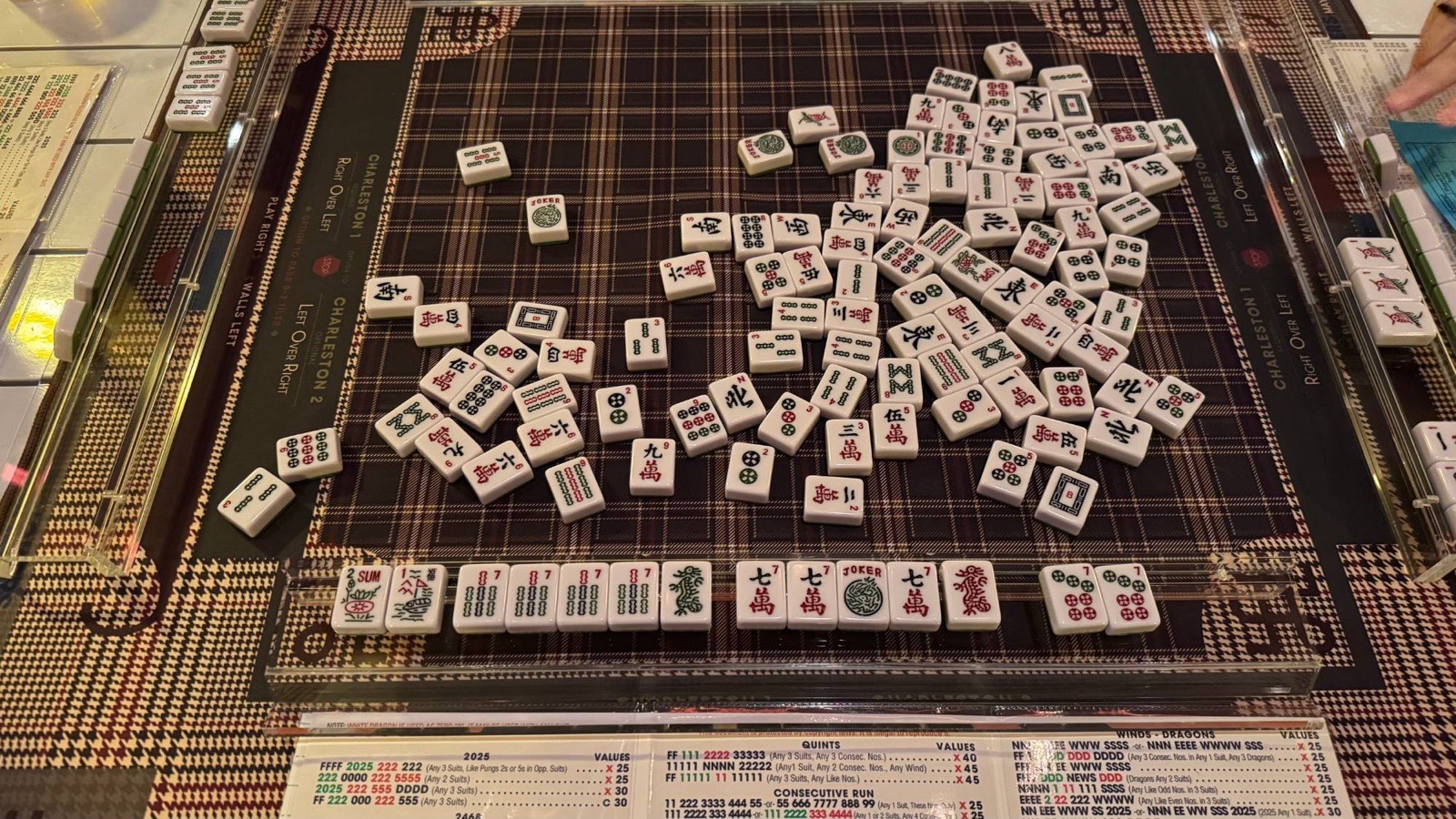
Look closely at your tiles
The Chinese characters on Craks and Winds and the bird on the 1 Bam come straight from the game's origins in 19th-century China. Even today's designer sets keep those traditions in some form.
Mah Jongg sails west
By the early 1900s Mah Jongg was a favorite across China. Foreigners in Shanghai and other port cities picked it up too. The person most often credited with bringing it to America is Joseph Park Babcock, an American working for Standard Oil in China. He simplified the rules for Western players and published a rule book in 1920, often called the "red book." He also trademarked the spelling "Mah-Jongg," the reason the American game is still spelled with two g's.
Sets were soon being imported to the United States, and the famous New York outfitter Abercrombie & Fitch was among the first stores to sell them. Demand grew so fast that importers reportedly sent buyers into Chinese towns to buy every set they could find.
The Roaring Twenties craze
In the early-to-mid 1920s, Mah Jongg became one of America's first great national fads. Women's clubs held Mah Jongg parties, newspapers printed lessons, hostesses dressed in Chinese-inspired costumes, and Tin Pan Alley turned out songs about it. Sets were made in every material from carved bone and bamboo to the colorful early plastics.
That success caused a problem. Different importers and authors published competing rule books, each with its own scoring and special hands. Players moving from one table to another couldn't agree on how to play. Several efforts were made to standardize the rules in the mid-1920s. By the end of the decade, though, the craze had cooled.
1937: The National Mah Jongg League is born
The game never disappeared. It found a devoted home among Jewish American women, especially in New York, who loved its mix of skill, strategy and conversation. In 1937, a group of enthusiasts met in Manhattan to settle the rules once and for all. Led by Dorothy Meyerson and Viola Cecil, they voted to form the National Mah Jongg League. Viola Cecil became the League's first president and Dorothy Meyerson its vice president.
The League's big innovation was the annual card. Instead of a fixed list of hands, the NMJL publishes a new card every year with a fresh set of winning hands. Players must learn new patterns each spring, which keeps the game lively and puts experienced players and newcomers on the same footing every year. The League has also long donated part of its card proceeds to charity.
What makes the American game different
Over the decades, American Mah Jongg grew into its own game, quite different from the versions played in China, Hong Kong, Japan and elsewhere:
- The card. You must win with one of the hands on that year's card, rather than any combination of sets and runs.
- The Charleston. The pre-game tile exchange is a uniquely American tradition. It's named, playfully, after the 1920s dance, with tiles moving right, across and left.
- Jokers. American sets include eight Jokers, wild tiles that changed the game's strategy and made long hands like quints possible.
- 152 tiles. The American set adds Jokers to the traditional tiles, Flowers and Seasons. All Flowers are played as one kind of tile.
- Year hands and Soap as zero. Each card includes hands that spell out the year, with the White Dragon standing in for zero.
Mid-century: the weekly game
After World War II, Mah Jongg moved with American families to the suburbs, summer resorts and retirement communities. The weekly game became a ritual: the same four friends, the same afternoon, the same clack of tiles, often for decades. Many of today's players learned by watching their mothers and grandmothers. Some still play with a treasured family set handed down through generations.
A modern revival
In recent years Mah Jongg has had a remarkable revival. A new generation discovered the game, especially in the 2020s, drawn by its social side, its brain-boosting strategy and the beautiful designer tiles, mats and racks now available. Mah Jongg clubs, classes, leagues and tournaments have popped up in cities and small towns across the country, including right here in Middle Tennessee.
That's where Let Us Mahj comes in. Whether you're carrying on a family tradition or touching tiles for the very first time, you're joining a story more than a century in the making.
Want to know more? The National Mah Jongg League shares its own history, and museums and libraries around the country have mounted exhibits on Mah Jongg's journey to America.
Header image: a hand-painted bamboo Mah Jongg set from 1923, photo by Cangjie6 (Wikimedia Commons), licensed CC BY-SA 4.0. Cropped and combined with a Let Us Mahj table photo; the combined image is shared under the same license.